On the first day of November 2022, around ten o’clock, one question started a chain reaction that would change the direction of my life and the lives of many others. I didn’t know that yet on that November morning.
I was at Salo IOT Campus giving a talk about psychological safety and its importance in working life. After the event, some of the audience stayed to chat with me. One of them thanked me for the presentation, and then became serious. “I have a question that doesn’t directly relate to this presentation,” she said.
Then the woman told me about her 11-year-old son, who had been an enthusiastic basketball player. Over the past year, the boy’s enthusiasm had faded. He was so nervous about games that he vomited before matches. The nerves had taken the joy out of playing.
The mother was visibly worried. She asked me for advice and said she had tried to encourage him, help him, and cheer him on. The situation hadn’t improved.
I felt helpless. I wanted to help, but I didn’t believe my advice would make a difference. I told the boy’s mother that even after 17 years as a professional, I still got nervous before games, so I knew you couldn’t just get rid of nerves that easily.
Over the years I had had a few teammates who still vomited before games even as adults, but that didn’t occur to me during the conversation. Still, I had an idea.
I suggested that I send a video message the mother could show her son. Maybe it could bring at least some relief to the situation, though honestly I wasn’t at all convinced.
The very first Encouragers video
To be perfectly honest, I forgot about the whole thing at first. My grandfather passed away that same week, so my mind was elsewhere. I remembered my promise six days later when the boy’s mother kindly reminded me of it. I wondered what on earth I should say. I decided I would tell the boy about my own experiences.
On November 7 at 5:03 p.m., I sent the mother a 58-second video message on WhatsApp.
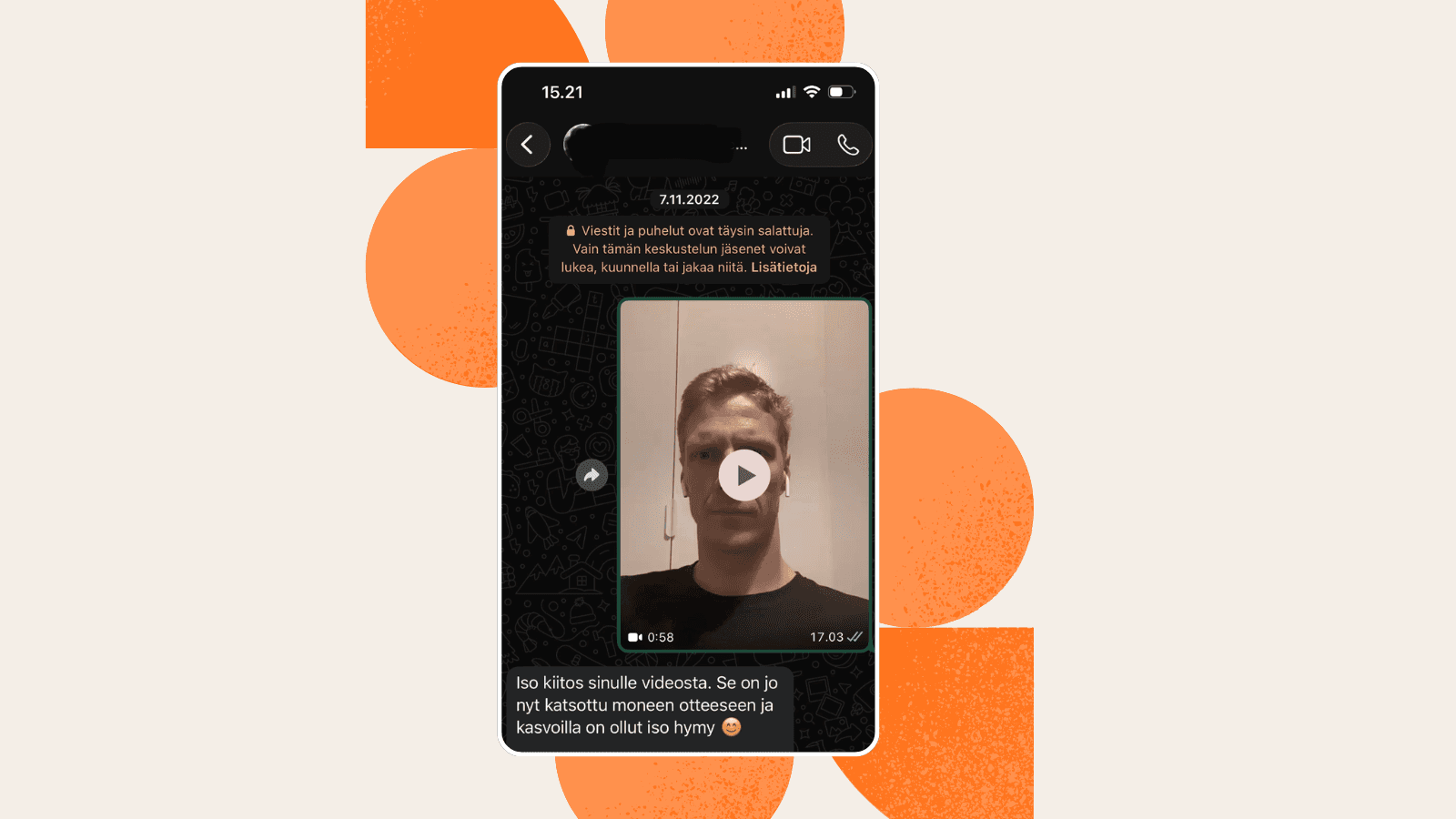
In the video I said that I still got nervous about games even after years of a professional career. I said I thought that was completely normal, because we often get nervous about things that matter to us. I described how I felt the nerves even prepared me for games and practices. For me, nerves were a sign that I was doing something important to me. I wished the boy good luck and asked that if he came to watch the game, he would give me a high five.
An hour later I got a reply from the mother.
“A big thank you for your video. It has already been watched many times, and there has been a big smile on his face 😊”
It was wonderful to hear that the video brought joy. A couple of weeks later I received a message that made my jaw drop.
“Last weekend there was another tournament and I think it was the first time all year that we managed to play without a stomach-emptying episode before the game. After the game, my son said that this time he wasn’t nearly as nervous. We’ve gone over the message you shared a lot—that nerves are preparation—so I believe it has made a difference!”
Just over a week later I heard once more how big an impact the video had had.
“I am incredibly grateful for the time and effort you put in. It would be hard to believe now that just in early autumn my son was asking whether he could quit basketball… Now the ball is constantly spinning in his hands, which means his enthusiasm has returned.”
I couldn’t believe how such a small gesture could have such a big impact (even now, as I write this, I can feel myself getting a little emotional around my eyes.)
On the first day of November 2022, around ten o’clock, one question started a chain reaction that would change the direction of my life and the lives of many others. I didn’t know that yet on that November morning.
I was at Salo IOT Campus giving a talk about psychological safety and its importance in working life. After the event, some of the audience stayed to chat with me. One of them thanked me for the presentation, and then became serious. “I have a question that doesn’t directly relate to this presentation,” she said.
Then the woman told me about her 11-year-old son, who had been an enthusiastic basketball player. Over the past year, the boy’s enthusiasm had faded. He was so nervous about games that he vomited before matches. The nerves had taken the joy out of playing.
The mother was visibly worried. She asked me for advice and said she had tried to encourage him, help him, and cheer him on. The situation hadn’t improved.
I felt helpless. I wanted to help, but I didn’t believe my advice would make a difference. I told the boy’s mother that even after 17 years as a professional, I still got nervous before games, so I knew you couldn’t just get rid of nerves that easily.
Over the years I had had a few teammates who still vomited before games even as adults, but that didn’t occur to me during the conversation. Still, I had an idea.
I suggested that I send a video message the mother could show her son. Maybe it could bring at least some relief to the situation, though honestly I wasn’t at all convinced.
The very first Encouragers video
To be perfectly honest, I forgot about the whole thing at first. My grandfather passed away that same week, so my mind was elsewhere. I remembered my promise six days later when the boy’s mother kindly reminded me of it. I wondered what on earth I should say. I decided I would tell the boy about my own experiences.
On November 7 at 5:03 p.m., I sent the mother a 58-second video message on WhatsApp.
In the video I said that I still got nervous about games even after years of a professional career. I said I thought that was completely normal, because we often get nervous about things that matter to us. I described how I felt the nerves even prepared me for games and practices. For me, nerves were a sign that I was doing something important to me. I wished the boy good luck and asked that if he came to watch the game, he would give me a high five.
An hour later I got a reply from the mother.
“A big thank you for your video. It has already been watched many times, and there has been a big smile on his face 😊”
It was wonderful to hear that the video brought joy. A couple of weeks later I received a message that made my jaw drop.
“Last weekend there was another tournament and I think it was the first time all year that we managed to play without a stomach-emptying episode before the game. After the game, my son said that this time he wasn’t nearly as nervous. We’ve gone over the message you shared a lot—that nerves are preparation—so I believe it has made a difference!”
Just over a week later I heard once more how big an impact the video had had.
“I am incredibly grateful for the time and effort you put in. It would be hard to believe now that just in early autumn my son was asking whether he could quit basketball… Now the ball is constantly spinning in his hands, which means his enthusiasm has returned.”
I couldn’t believe how such a small gesture could have such a big impact (even now, as I write this, I can feel myself getting a little emotional around my eyes.)
The follow-up discussion on social media touched me deeply
I asked the boy’s mother if I could write about what had happened on social media — about how a small word of encouragement can have a big impact, and how our own mindset affects the way we experience things. She liked the idea, and I published the post.
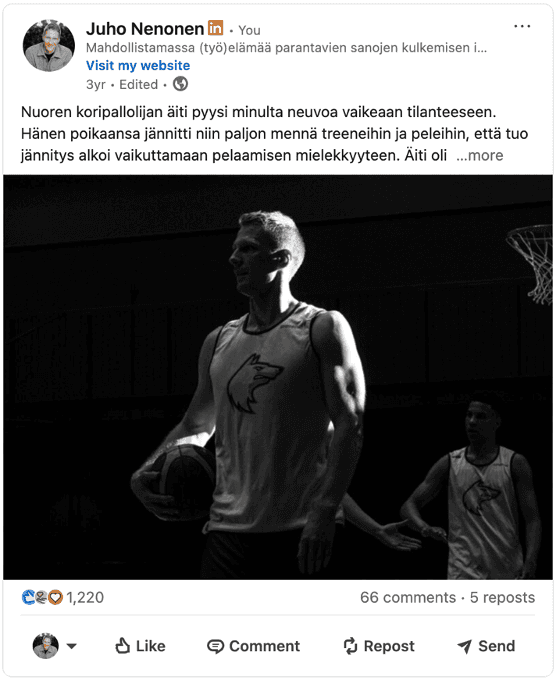
Many parents of children and teens reacted to the post and commented on it. Inspired by the post, the father of a 10-year-old boy told me about his child, who wanted to start playing basketball. But the boy was nervous, because the others had started the sport much earlier. He feared that 10 was too old to begin.
Reading the father’s words, I realized how painful it felt to think the boy might miss out on trying because of such a “small” reason. Of course, for the boy the reason was not small at all — it was real — but from my own experience I knew that 10 was not too old to start. I began my own basketball career when I was older than that.
I replied to the father and asked whether he would like an encouraging video for his son. I could share how I started playing at an older age than him and encourage him to give basketball a chance. Maybe the message could ease any unnecessary worries about starting.
The father replied that he didn’t feel comfortable asking for something like that. I decided that in that case, I could send the video without being asked.
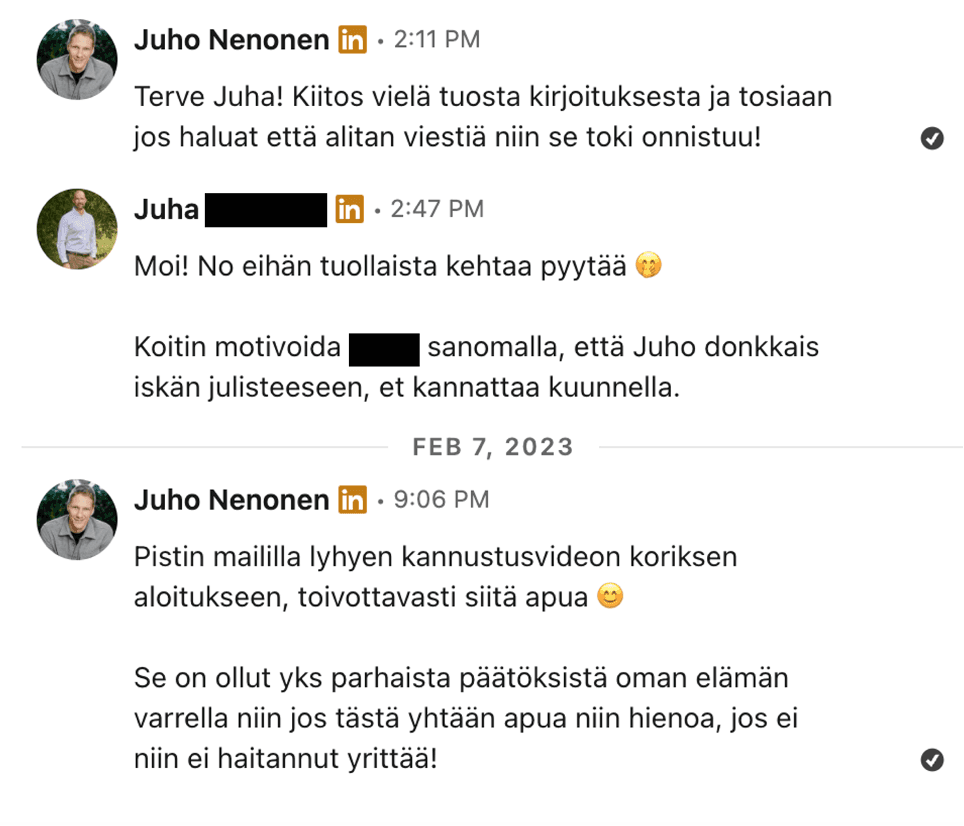
It was 48 seconds long. I explained that I started my own basketball journey at a relatively late age. I also said that basketball can help you make friends, and that learning it is far from impossible. I warmly encouraged them to give the sport a chance.
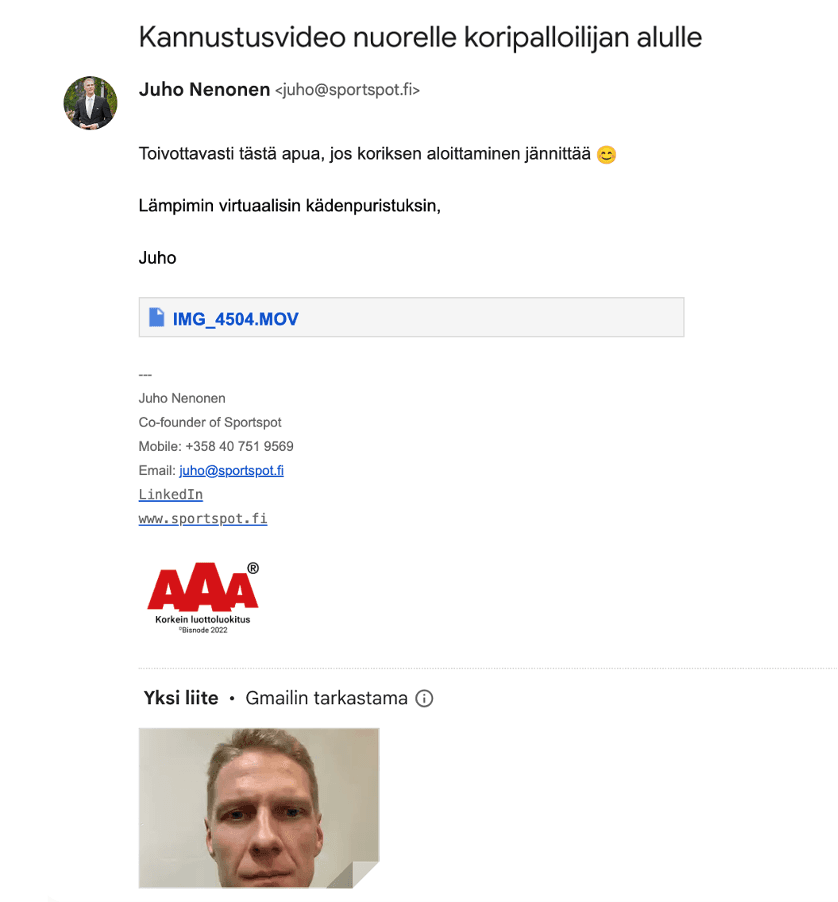
I wondered whether the message would have any effect. The answer came the next day by email.
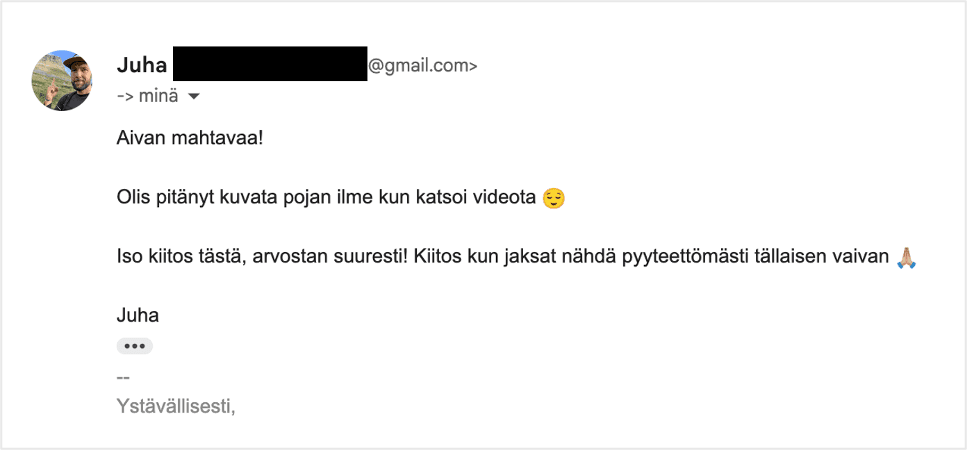
Next, I received a message from the father saying that the boy had found the courage to go to practice. A couple of weeks later, I heard that the boy had started the sport for real. Even then, I could never have imagined the wave of positive momentum the video would set in motion.
Six months later, I received another email from the father. Tears came to my eyes as I read it.
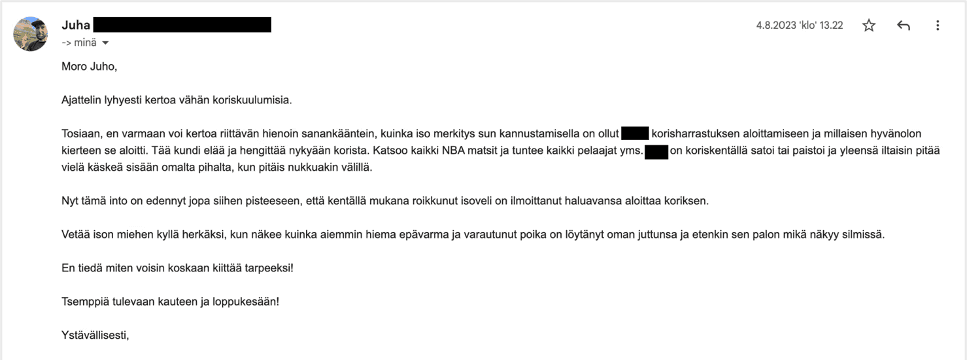
It’s hard to describe the feelings that arise when you realize you have helped influence another person’s life in such a positive way. In that moment, life felt meaningful.
Two questions grew stronger in my mind: Could this work with other children too? Could we build something bigger from this?
The next level of encouragement
What if we created an opportunity for parents, coaches, and other trusted adults to request an encouraging message in a situation where a child or young person needs words of encouragement, and a parent's words alone are not enough? What if asking did not have to feel awkward, but instead was made easy and meaningful?
I told my teammates what had happened and asked whether they would be willing to send similar messages. Everyone said yes. We began developing the concept with my colleagues, Teemu Harinen and Jani Piipari. I sent more encouraging videos, and the effects were similar to those of the first messages.
We envisioned a service that would connect people who needed words of encouragement with those who could offer them. As I studied the psychology of encouragement, I realized this could truly be done on a much larger scale.
We presented the idea to the Ministry of Education and Culture, and they were excited. I still remember the meeting where Tiina Kivirauma asked, in delighted surprise, "Hasn't something like this ever been tried before?" No, it hadn't—not on this scale, at least. At the heart of the project were preventing drop-out and encouraging children to stay active. In Finland, the phenomenon is at a high level compared with other European countries, and although the reasons are many, perhaps we could inspire children either to overcome their challenges or to try another sport instead of quitting physical activity altogether.
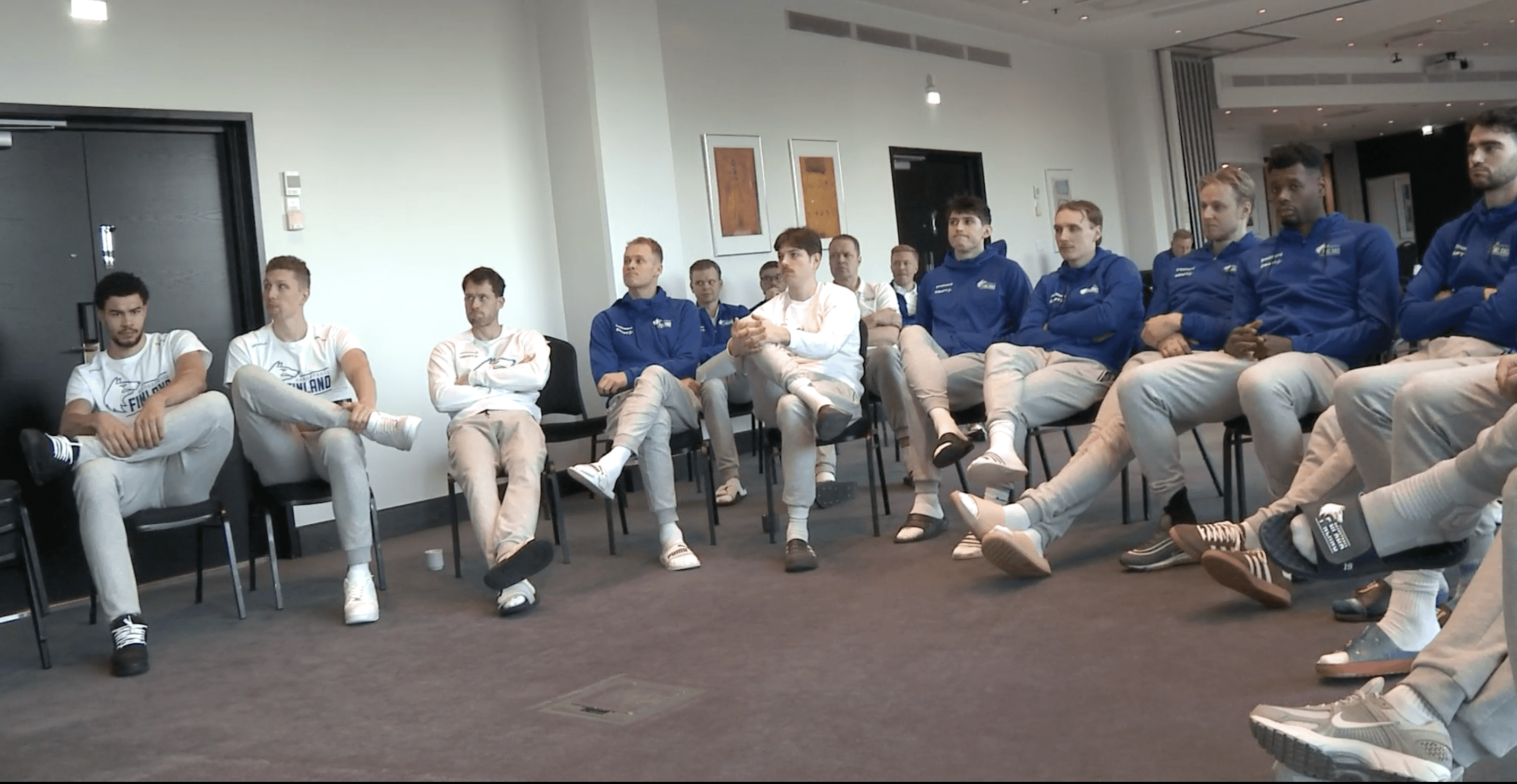
We asked the Finnish Basketball Association to join us as a partner and launched the project in October 2024, when the Ministry of Education and Culture began supporting the work. I pitched the idea to national team emeritus coach Henrik Dettmann, who was immediately enthusiastic. After that, I presented the idea to the national team head coach Lassi Tuovi, who invited me to the national team camp in November 2024 to explain the whole concept. When I asked who was willing to get involved, every player raised a hand.
Special thanks to Susijengi captain Sasu Salin, who has been one of the most dedicated Encouragers and, as the video shows, also the teammate who encouraged the rest of the team to join already in 2024 by setting an example himself. That small pause before the other players followed the captain's lead made my own knees shake.
The enormous power of encouragement was revealed
If we fast-forward through 2025, it can be described in one word:
Success.
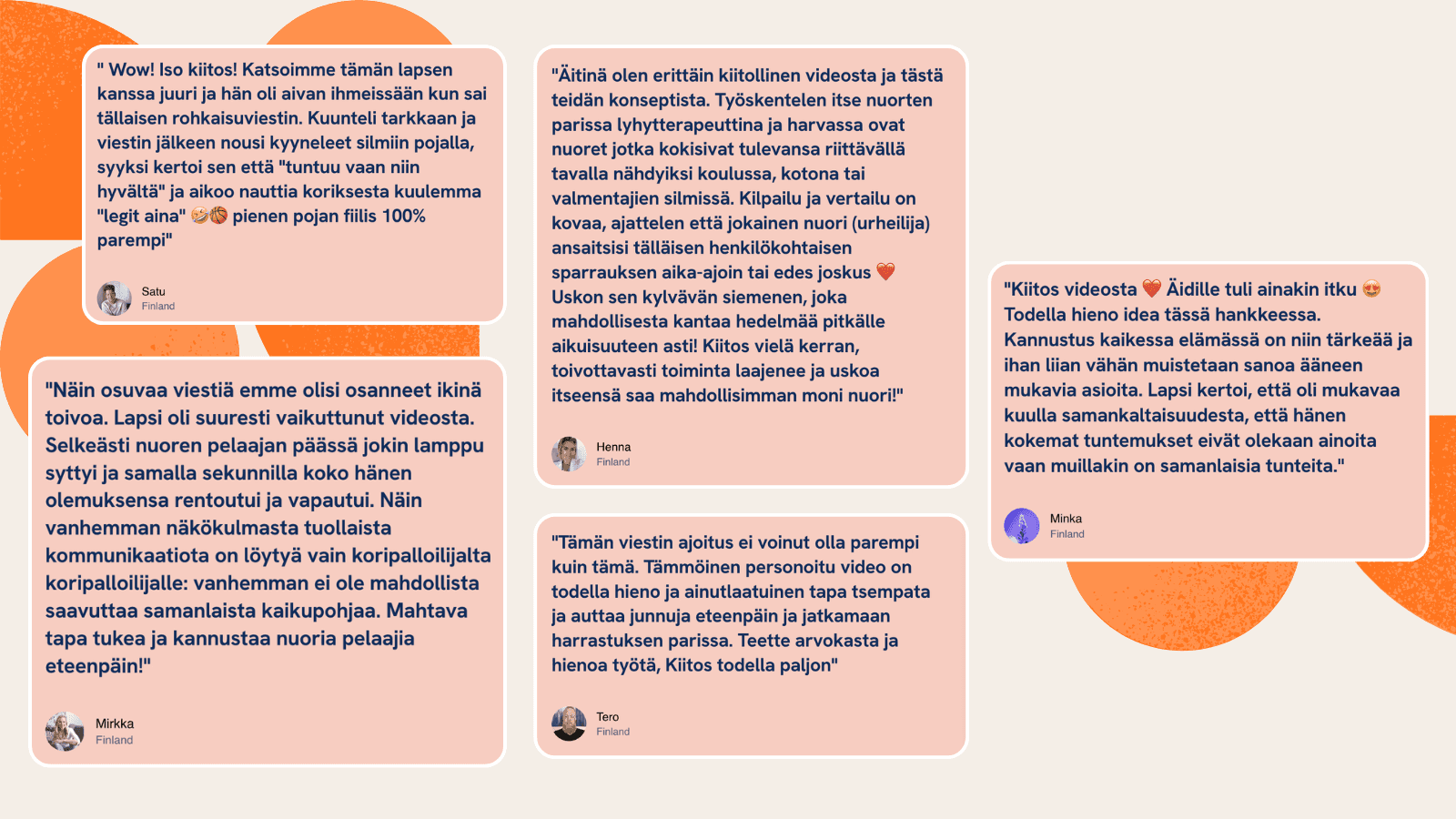
Even though we had already tested the effectiveness of video encouragements on a smaller scale and refined the concept extensively before launching the project, during it we realized just how powerful encouragement truly was. It came through strongly in the feedback. Almost every week, a parent told us how they were moved to tears first when seeing the video, then again when seeing their child's reaction to the message and the video's effect.
When we sent a feedback survey at the end of 2025 to all more than 300 recipients of an encouraging video, over 50% responded, and 100% of respondents recommended the service to other parents. On a scale of 1-10, the videos received an average score of 9.73 (NPS 93). In addition, 81.5% (!!!) reported noticing a concrete positive change in their child.
Here are a few examples of the feedback:
Every week we read similar stories about just how powerful encouragement is. But let's get back to it.
Unexpected effects on the Encouragers
Encouragement didn't affect only those receiving it, but also the Encouragers. During the project itself, we began receiving feedback about how good it felt to create encouragement and how it affected the Encouragers themselves.
I had not thought about this before expanding the activity, but when more and more similar feedback started coming in, it was obvious why. As author and historian Rutger Bregman has said:
"You are not a good person because you do good things. You become a good person when you do good things."
We had succeeded in creating a mechanism through which the Encouragers could do incredibly good things and receive feedback on the good they had done. When they saw the impact of their actions, it changed how they saw themselves. I can say from experience that hearing this feedback has had a significant effect on me as well.
Over the course of the year, we also learned a great deal about how little it ultimately mattered how well known an Encourager was. Most of the requests were addressed to the stars of Susijengi: Lauri Markkanen, Sasu Salin, and Mikke Jantunen. When the message was delivered by Daniel Dolenc, Remu Raitanen, Linda-Lotta Lehtoranta or some other local standout, the feedback was not "who the heck is this?" but rather "This is my new favorite player!" (Knowing the Susijengi stars, I know this isn't a problem. Their egos can handle others shining as role models too.)
"This is not a project, this is a movement"
We also realized how eagerly people wanted to join. I have been involved in many projects, but this was the first time top-level volunteers came on board simply because they thought the project was so unique and the vision so exceptional. We stopped calling the whole thing a project, because projects end, but movements move forward and grow. They take on a life of their own.
And that's not all: when we have asked the players whether they would like to be paid for the videos, the consistent answer has been "no thanks". This makes it possible for the videos to remain free for parents now and in the future.
However, we do want to reward all the volunteers in some way, too, which is why we are building a few exciting networks around the Encouragers movement. I'll come back to those when the time is right. Stay tuned…
There is a desperate need for encouragement – you can help too
The world is going through a time colored by crises and anxiety. Right now, many people need more encouragement than they have in a long time. If we can support one another better and offer the keys of encouragement with our words even to strangers, I believe that makes a better future possible.
What do we at Encouragers want to achieve? Our vision is to create the world's largest community and platform of encouragers, through which people in need receive the right words at the right moment.
There are already over a hundred Encouragers, and the number keeps growing. Although we started with basketball, more than 20 sports are now represented, and influencers from different areas of life are involved.
The Encouragers journey is still at an early stage, but if you want to help us, tell us about a potential Encourager you know, or encourage them to get in touch with us directly (https://rohkaisijat.fi/rohkaisijaksi) or juho@rohkaisijat.fi. We are constantly looking for more Encouragers so that we can pass on life-changing words to more and more people. Even one message can make all the difference for a child or young person.
Follow our journey so you stay up to date on how the movement is growing, and get practical advice on how you can support a better life for yourself and your children. You can subscribe to our newsletter here. Also follow Encouragers on Instagram.
If you would like to discuss deeper collaboration or have innovative ideas, please get in touch. We need expertise, resources, and contacts so we can expand the work. And yes, go to www.rohkaisijat.fi and leave an encouragement request if you need one. The service is available!
Stay tuned, because more encouraging news is on the way.
With encouraging regards,
– Juho & R/ohkaisijat-team
Juho Nenonen is a former professional basketball player, current entrepreneur, and one of the founders of the Rohkaisijat movement.
Thanks: who has made all of this possible?
Over the past three years, a huge number of people have worked with us and made everything that has happened so far possible. We are only at the beginning, but here I want to thank those who have helped make the Rohkaisijat movement a reality.
My business partner Teemu Harinen has been involved from the very beginning in bringing this vision to life and has created the framework for our encouragement infrastructure to work so that we can deliver these meaningful video messages to those who need them. Panu Luukka, recognized for his expertise as a company culture expert, has volunteered for the movement for over a year and has, for example, helped with concept development and message delivery. Technology entrepreneur Andrei Neagu has helped in many ways for the second year now. Jani Piipari, Jallu Raitanen, Kim Väisänen, Christina Dahlblom, Marko Airamaa, Sheiks Mohammed, Sofia Lund, Jere Nevalainen, and many others have used their time and networks to help. A huge thank you to all of you!
Laura Lepistö has taken the movement into figure skating, where, if possible, the feedback is even better than on the basketball side. And Johanna, Emilia, and Taru from Unfair Lean Marketing, who have helped with designing the overall concept and sharpening the messages (and created the wonderful logo).
Child and adolescent specialist psychologist Viivi Naapi has helped develop the concept and consulted in challenging situations. Professor Gregory M. Walton, deputy director of the Dweck Lab at Stanford University and an expert in brief interventions, has been a huge help in teaching us how to guide the Encouragers in creating the best possible videos, and his theories have laid the foundation for the scientific development of the entire concept.
The Finnish Basketball Association has been a fantastic partner and source of support as we have brought the good news of encouragement to families with children and young people. A huge thank you to Kati Packalen, Heini Santos, Henrik Dettmann, Lassi Tuovi, and everyone else who has worked with us at the association as partners in building the movement. And of course to the entire Susijengi and Susiladies group, who have been involved from the very beginning.
Special thanks to President Sauli Niinistö, who was excited by the idea and became the movement's patron.
Above all, thank you to all the Encouragers who make this work possible <3
Revision 10.4.2026: I was pretty sure I'd forgotten to thank someone, and it turned out there were a few more people who have been part of the journey. Special thanks to the people at the Ministry of Education and Culture: Tiina, Satu, and Hannu, who believed in this idea. Antti J. Peltonen, who brought new ideas to the concept in its early stages, and a huge thank-you to all the parents who have asked for encouragement for their children!